

We’ve just hit the quarter century mark. The decade is shaping up to be one of tremendous change. To succeed leaders must adopt strategies that foster focus, resilience, and growth. The SPACE framework, developed through a decade of experience with Fortune 100 executives, offers a roadmap to achieving these goals.
Speed up high-quality decisions.
Prioritize what matters most.
Activate team energy.
Communicate with clarity.
Empower at every level.
Why is SPACE essential for high-performing leaders? In any organization, distractions can derail focus even after a solid plan is established. A leader’s role is to maintain and drive that focus throughout the team. By consistently applying the SPACE framework, leaders can create an environment that fosters clarity, alignment, and confidence, enabling everyone to achieve their goals.
Dive Deeper
Speed up high-quality decisions
In business speed and good judgement matter. You can make the most thoughtful decision in the world, but if someone else acts faster, you risk missing the opportunity.
“Speed is not your enemy, hesitation is.” – Idowu Koyenikan
Many decisions in business are reversable. Taking calculated risks based off the best information available is crucial not only to business but also for your teams. Teams stagnate when leaders delay decisions, waiting for perfect information. Or worse, never deciding at all. Leaving the team to decode what move the leader is making.
Bottom line, to make real progress leaders need to be decisive in their actions whether they take the decision or delegate the final decision to someone else.
Tips and tools
- The RAPID acronym outlines the roles of participants in a decision: recommend, agree, perform, input, and decide. It was designed by the consulting firm Bain & Company.
Prioritize what matters most
According to the McChrystal Group, teams that articulate which projects take priority had an average 40% higher company income growth one year later vs. companies whose leaders struggle to articulate priorities. Additionally, teams that prioritize have better work rhythms, which is critical for employee retention.
Good leaders identify initiatives that connect to the company objectives. Great leaders drive prioritization conversations to uncover redundancies, disconnected initiatives, and conflicting priorities.
Where to start
- Be clear about your outcomes. As you are bombarded with new inputs, come back to the outcomes to help your decision making.
- Gather your list. However, an unranked list is as useless as a chocolate teapot.
- Determine what is urgent and what is important. Do not confuse the two. Important is not always urgent and vice versa. When an item is both that’s a sign that it should be on high on the list.
Tips and tools
- Begin with the Start/Stop/Continue model.
START: What specific actions need to start to deliver the initiatives identified?
STOP: What specific actions need to stop?
CONTINUE: What specific actions need to continue?
- When it gets tough put items on stand-by. Essentially, you are creating a waiting list of items to be moved up or down. This allows for the team to flex based on new information and new circumstances.
Activate positive energy
Inspired employees are far more productive and, in turn, inspire those around them to strive for greater heights. While fast decisions based on clear priorities are key, without inspiring your team you have nothing. No creativity. No growth. No foundation for innovation.
According to Bain & Company’s research on what makes a leader inspirational there are 33 behaviors that are most powerful in contributing to inspiration.
However, there is one that stood out, Centeredness. As they define it, Centeredness is a state of greater mindfulness, achieved by engaging all parts of the mind to be fully present.
While having Centeredness proved to be a central attribute, having any four strengths makes you 91% more inspirational. That finding underscores that inspirational leaders come in many varieties.
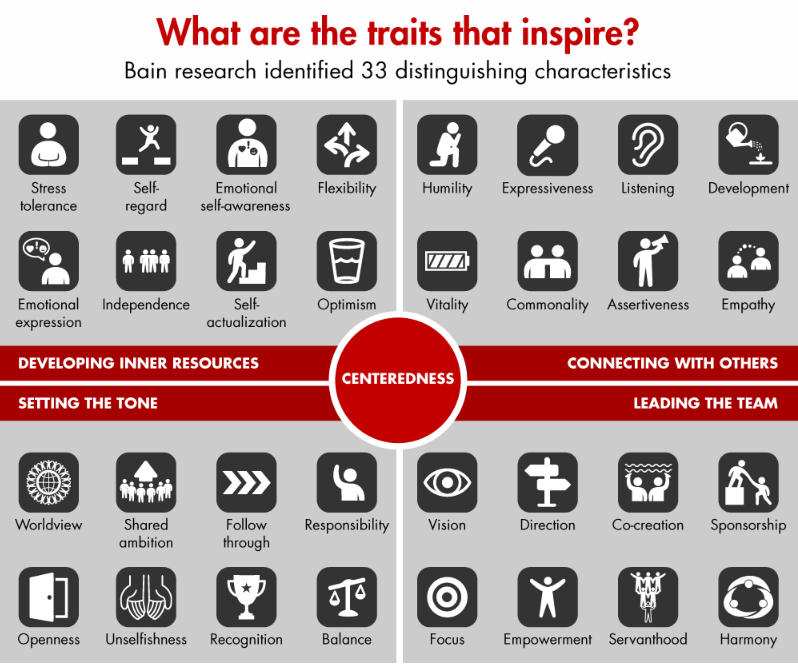
What’s imperative for leaders is to actively model the behavior they want from their team. This will help create an environment where everyone can do their best work.
Tips and tools
- Read more: HBR.org How to Be an Inspiring Leader
Communicate with clarity
Can you remember back to a time when you were in a meeting and left having no clue as to what the discussion was about, if there was a decision, or next steps? We’ve all been there. These are the meetings that give meetings a bad name. Why does this happen because there isn’t clarity. As Brene Brown says, “Clear is kind.”
Knowing how to communicate the right thing to the right people at the right time has is an invaluable skill-set. In addition to the “rightness” is the skill of communicating clearly. Being clear on your expectations, simplifying complexity, ensuring shared understanding, and defining a next course of action is a hallmark of an experienced leader.
How to do this?
- Use signposting to give clear cues and reduce miscommunication.
Example: “I have two points….” Or “At the end of this conversation I want to have a decision on…”
2. Use short words and short sentences.
Example: In 2007, Bezos explained the benefits of Amazon’s newly introduced Kindle in a paragraph a seventh grader could understand:
“If you come across a word you don’t recognize, you can look it up easily. You can search your books. Your margin notes and underlinings are stored on the server-side in the “cloud,” where they can’t be lost. Kindle keeps your place in each of the books you’re reading, automatically. If your eyes are tired, you can change the font size. Our vision for Kindle is every book ever printed in any language, all available in less than 60 seconds.”
3. Choose relevant metaphors to reinforce key concepts.
Example: Steve Jobs famously described the first iPod as “1,000 songs in your pocket.”
Tips & Tools
- Made to Stick, by Chip and Dan Heath
- Smart Brevity, by Jim VandeHei, Mike Allen and Roy Schwartz
- Clear is Kind, by Brene Brown
Empower at every level
How do you retain your most valuable company asset, your people? Empowerment. It is associated with improved job satisfaction, organizational commitment, performance, and morale. Empowered employees feel accountability and are more likely to be productive and hit their targets. Additionally, it also gives leaders more time to focus on the most significant and complex decisions and explore new sources of growth.
If you’ve clearly shared the vision, prioritized what matters most, identified who will make the final decision, then the team is equipped with what they need to move the project forward with confidence.
Tips & Tools
- HBR Article: 5 Strategies to Empower Employees to Make Decisions
In an era defined by rapid change and constant demands, the SPACE framework equips leaders with actionable strategies to ensure clarity, alignment, growth, and to maximize their Return on Minute.
- Speed: Make timely decisions without compromising quality, ensuring progress and preventing stagnation.
- Prioritize: Focus on initiatives that matter most, balancing urgency with importance to drive meaningful outcomes.
- Activate: Inspire your team by modeling centeredness and creating an environment that fuels creativity and innovation.
- Communicate: Simplify complexity and ensure shared understanding through clear, concise, and purposeful communication.
- Empower: Delegate authority to foster accountability, improve morale, and free leaders to focus on strategic priorities.
By embracing these principles, leaders can confidently navigate challenges, drive team performance, and position their organizations for long-term success.
Image created by Bing Image Creator




 Return On Minute
Leave a comment