

Every International Women’s Month, someone publishes a list of the most powerful women in business. LinkedIn fills with celebration posts. Companies announce commitments. What those posts don’t show: the invisible hours those women spent that their male peers simply didn’t.
Before AI took meeting notes, women did. Time and again I watched as senior women exchanged glances across the table when they were asked to do this task. And those who pushed back were labeled as “difficult to work with.” A catch-22 that made declining these tasks feel professionally risky long before anyone had language for it.
Let’s look behind the curtain — at the cost, and how to take your time back.
System Failure
When an undesirable task hits a mixed-gender team and no one volunteers, women step up twice as often as men. Put those same people in a same-gender group, and the gap disappears entirely — men volunteer at exactly the same rate, according to Harvard Kennedy School GAP research. This isn’t biology. It’s a social dynamic that only exists when men and women are in the same room.
The consequences compound. The No Club researchers discovered that every data source revealed that women are doing more of the non-promotable tasks (NPTs) than men. At one professional services firm, women spent roughly 200 more hours per year than their male counterparts on NPTs. That’s not a rounding error. That’s five extra weeks of work — every year — advancing someone else’s agenda while quietly eroding their own.
Institutions that pursue equal committee representation without accounting for gender ratios make it worse. When only a third of faculty are female but committees require equal gender representation, women end up carrying twice the service load of men. Progress with unintended consequences is still a problem.
What Are NPTs, Exactly?
Non-promotable tasks keep organizations running but don’t move careers forward: onboarding the new hire, taking meeting notes, sending status reports, staffing the DEI committee, mentoring the junior colleague who cold-emailed. The organization needs these things done. Upper management just doesn’t value them the same way they value revenue-driving work.
The distinction sharpens at senior levels. What counted as a stretch assignment early in your career becomes invisible overhead at Director or SVP. The tasks didn’t get less real. They just stopped counting.
Consider Theresa, an aeronautical engineer profiled in The No Club. She managed a mentorship program for women in her division. The time she invested came directly out of her engineering and management work — and she was passed over for a major promotion. She left. The women who remained, furious, stopped doing DEI and mentoring work entirely. The organization lost both the talent and the culture it was trying to build.
Every Yes Hides a No
When you agree to run the mentorship program, you’ve implicitly declined something else — a high-visibility project, a stretch assignment, or the preparation time for a meeting where your ideas need to land.
The research is direct about the mechanism. Women receive 44% more requests for low-reward, high-effort tasks than men. When women say no, they face professional backlash. When they say yes, they receive little to no reward. Men face none of that — and are even praised when they volunteer. The social cost of refusal is structurally higher for women, which means the rational calculation almost always points toward accepting.
“Our society views women’s time as infinite like sand, whereas we guard men’s time as if it’s finite like diamonds.” – Eve Rodsky, author of Fair Play
An MIT Sloan study of 30,000 management-track employees found that women receive 8.3% lower “potential” ratings than men — even when their performance ratings are higher. Up to half of the gender promotion gap traces back to this single variable. The NPT load is one reason women appear less strategic: they’re visibly executing support work while male peers are being seen on career-defining projects.
And once you own an NPT, you own it indefinitely. Do a good job once, and the task becomes yours forever.
The Inequality Tax
The burden doesn’t fall evenly. McKinsey’s Women in the Workplace report found senior women are twice as likely as senior men to do DEI work outside their formal job responsibilities. For women of color, the ask comes from every direction at once: DEI committees, ERG leadership, mentoring requests — and on top of all of it, the invisible labor of code-switching.
A Cornell University study found that chronically monitoring speech, appearance, and behavior to be perceived as professional is not a choice but a necessity. It never appears on a calendar. It drains the same finite cognitive resources that the calendar tasks do.
For women of color, the research shows it’s heavier at every level — and that’s not something I can speak to from lived experience. What I can do is name it accurately and make sure the framework below accounts for it.
The Framework: The Return on Minute R.I.S.E. Matrix
Most advice at this point defaults to “just say no.” The research is blunt: unless you have tenure and substantial political capital, that’s structurally risky. The problem isn’t women’s willingness to decline. It’s that the system makes declining professionally costly in ways it doesn’t for men.
As Director of Operations in the Office of the CEO at Microsoft, I ran quarterly time audits with 15-minute precision. One pattern was impossible to miss: male executives received significantly more unplanned access to Senior Leadership than their female counterparts. Not because of performance. Because of proximity. And proximity is a function of where your time goes.
That experience led me to build the Return on Minute R.I.S.E. Matrix — a decision framework that guides you on what to do, negotiate, approve, or eliminate. The goal isn’t to stop contributing. It’s to stop contributing for free.
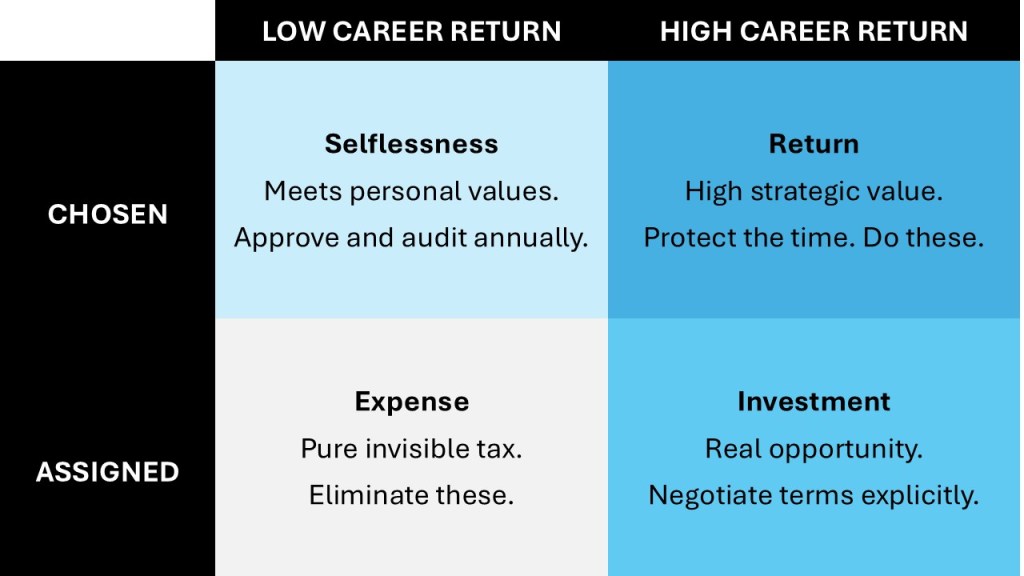
The R.I.S.E. Matrix classifies each NPT across two axes: career return and assignment origin:
- Career Return — Does this build visibility, management recognition, relationships, or skills that advance my goals?
- Assignment Origin — Did I choose this, or did it arrive because of who I am?
How to R.I.S.E.
Categorize tasks or projects into one of four quadrants:
- Return — High career return, you chose it. These are the NPTs worth protecting: the ERG leadership role that puts you in the room with the CHRO, the mentoring relationship that’s genuinely two-way, the cross-functional project that expands your scope. Do these.
- Investment — High career return, assigned to you. These deserve scrutiny, not automatic acceptance. The ask may be legitimate and the opportunity real — but don’t absorb these silently. Negotiate the terms, timeline, and recognition explicitly.
- Selflessness — Low career return, you picked. Sometimes you take on tasks that won’t advance your career but build organizational goodwill or reflect your values. That’s a legitimate choice — as long as it’s a choice, not a default. Approve and audit annually.
- Expense — Low career return, assigned to you. This is the invisible tax in its purest form: the status updates no one reads, the committee that meets quarterly to produce nothing. These are the hours that build someone else’s career while stalling yours. Eliminate these.
Get the template here.
Your NPT Audit
The RISE Matrix tells you what to do with each commitment. The audit tells you what you’re actually carrying.
A 12-year Harvard Business School study tracking 60,000 hours of CEO time found that the gap between how leaders intend to spend their time and how they actually spend it is both predictable and correctable. The same discipline applies to your calendar. When I first ran this for myself the number surprised me, but the relief liberated me. It brough clarity to what I was feeling but couldn’t put into words.
Step 1: Pull your last 90 days. Log every recurring commitment, one-off meeting, and project. Flag anything NPT: behind-the-scenes, not tied directly to your core priorities, something anyone could have done.
Step 2: Run each item through the RISE matrix. What was the career return? Did you choose this, or was it assigned — and if assigned, why you? “I felt I couldn’t say no” is a data point, not a justification.
Step 3: Quantify the tax. Total the hours. Multiply by four. If the research average holds anywhere near your experience, you’ll find something close to 200 hours — five weeks — committed to work that isn’t building your career. Write that number down.
Step 4: Identify one exit and one negotiation. Don’t overhaul everything at once. Exit one Expense commitment — gracefully, with a transition plan. Renegotiate one Investment commitment explicitly: ask for credit, scope reduction, or recognition.
The Bottom Line
This International Women’s Month don’t just celebrate what women accomplish. Make a commitment to your own career, your own time, yourself.
The 200 extra hours aren’t a personal failing. They’re a systemic problem with a measurable cost — and now, a framework to correct it. The system won’t fix itself this quarter. Your calendar review can happen this week.
Like this article? You might also enjoy:
- Five Time Saving Bets That Will Separate Leaders From Laggards in 2026
- Why AI Makes Your People Faster But Your Organization Slower
- Five Prioritization Frameworks Every Leader Should Know
Written in collaboration with AI




 Return On Minute
Leave a comment