

Before your team opens a laptop, some of them are already working — on a project that will never appear in a status update.
The calculation happens fast: Should I mention my partner’s name? Do I skip the small talk about the weekend? If I push back in this meeting, will I confirm something I’m trying not to confirm? For LGBTQ+ professionals — and many others who code-switch to survive their work environment — this is the invisible first shift of every workday.
Covering isn’t only a culture problem. It’s a productivity problem — running quietly under the surface of your team right now.
I missed it. And I was trying not to.
On one of my teams, there was someone who never shared much during Monday standups. I assumed it was personality. What I didn’t realize: this person was self-monitoring before saying a single word — calculating what was safe to reveal.
As the mother of an LGBTQ+ child, I consider myself an ally. I still missed it. That’s exactly the problem.
McKinsey data shows 45% of LGBTQ+ workers feel they must be careful discussing their personal lives at work — a constant, low-grade form of self-monitoring. More than one in four aren’t broadly out at work at all. Even among senior leaders, one in five LGBTQ+ executives aren’t broadly out. Seniority doesn’t solve this.
But senior leaders can.
Policy Stagnation
Here’s the definition worth knowing: Covering means hiding some element of identity, altering appearance, or avoiding topics to assimilate into mainstream workplace norms. Sociologist Erving Goffman coined the term; law professor Kenji Yoshino brought it into workplace research; Deloitte measured it across 1,269 U.S. employees in their 2023 Uncovering Culture study. Eighty-three percent of LGBTQ+ employees cover at work, compared to 61% of employees overall. That 22-point gap is the tax differential.
What’s truly frightening is the covering rate hasn’t moved in a decade. When Deloitte first measured this in 2013, 61% of workers reported covering. Their 2023 follow-up found essentially the same number. Ten years of DEI programs, nondiscrimination policies, and Pride Month activations — and the needle is stuck.
The Cost of Covering: The Hidden Time Tax
Only 50% of workers report their team leaders create the psychological safety needed to uncover. The numbers are worse for workers from marginalized groups. LGBTQ+ employees report higher rates vs. their non-LGBTQ+ counterparts – 74% of report higher emotional fatigue from pressure to cover, 65% say they’ve seriously considered quitting due to covering, and 63% say it specifically impacts their ability to perform at their best.
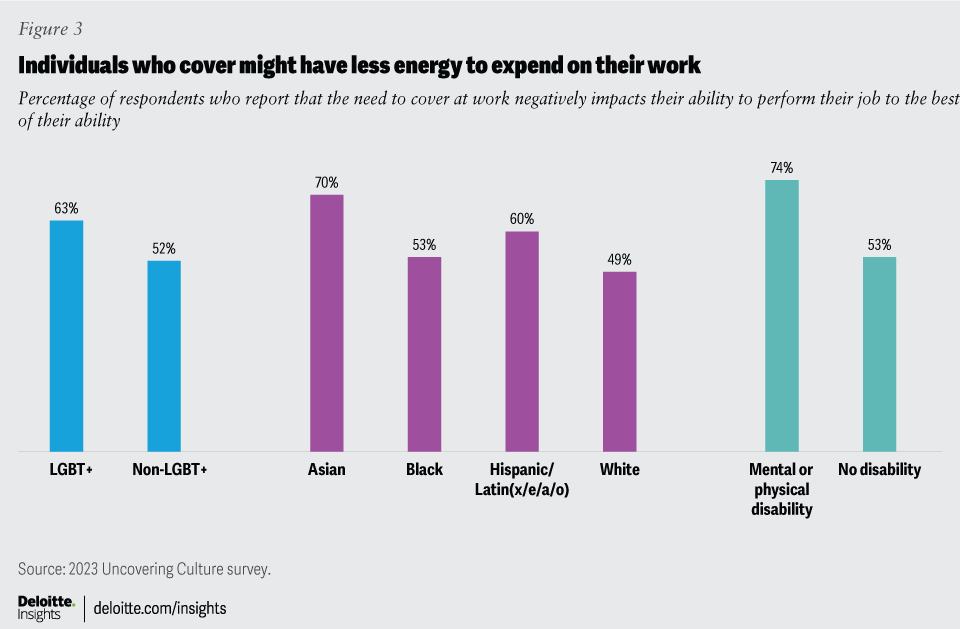
The American Psychological Association’s research on task-switching shows that even micro-shifts carry measurable time and energy costs — and that interruptions as short as five seconds can triple error rates in complex cognitive work. Covering isn’t a five-second interruption. It’s a background process running continuously, diverting mental bandwidth from actual work.
Jim Fitterling, CEO of Dow, spent 30 years covering before coming out to employees in 2014. He later described it this way:
“I know what it’s like to spend energy and mindshare hiding who I am. It can affect your ability to contribute. Part of you, sometimes all of you, goes into a shell.”
There’s also a compounding effect at the top. A 2024 Deloitte report found that C-suite or other executives and senior manager respondents had the highest rates of covering across organizational roles, at 67%. And 54% of workers report their need to cover increases when interacting with senior executives. When leaders cover, they inadvertently signal that everyone else should too.
Bottom Line: The cost of covering shows up in attrition and output. By then, it’s expensive to fix.
Culture Eats Strategy for Breakfast. Three moves you can make now.
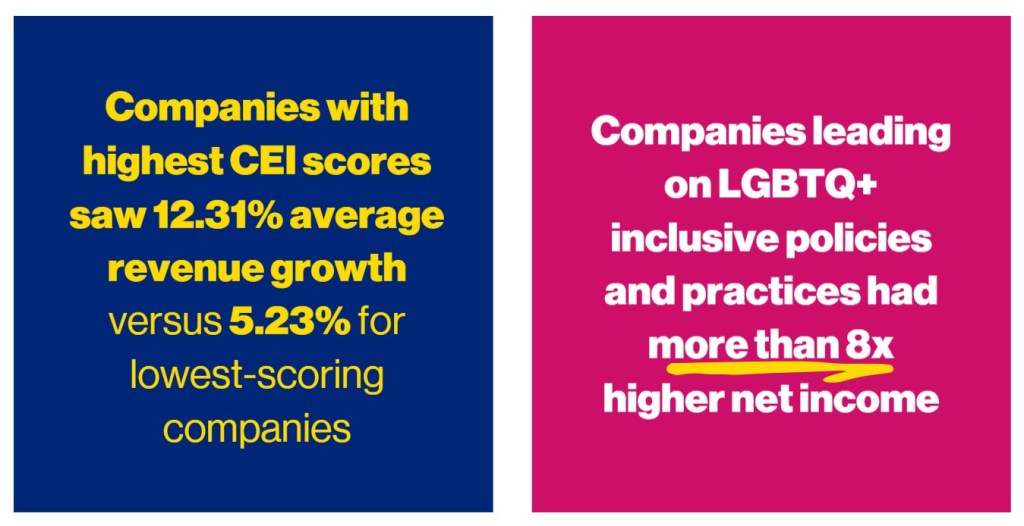
HRC’s 15 years of Corporate Equality Index data shows companies leading on LGBTQ+ inclusion consistently outperform their peers financially. McKinsey found that LGBTQ+ women who are open about their sexuality at work are half as likely to plan to leave their employer in the next year compared with those who are not out.
Amy Edmondson’s psychological safety research, validated across 185 studies, identifies inclusion safety — the felt sense that one can be authentic without penalty — as the foundational first stage of a high-performing team. Before innovation, before healthy challenge, before any of the dynamics that drive performance: people need to know their presence is safe. According to the Edelman 2025 Trust Barometer, employees who trust their employer are significantly more likely to remain engaged, productive, and committed to staying with their organization, while low trust is strongly associated with increased intent to leave.
Leaders who create conditions for people to stop covering don’t just do the right thing. They unlock capacity that was always there.
Here’s how to start:
1. Share one piece of personal context this week. In a meeting, a Slack message, a kickoff. Not performatively — just naturally. Notice who follows. Leaders who model authenticity are the single most powerful lever for reducing covering culture on their teams. That’s not a soft gesture; it’s an evidence-based signal that changes the safety calculation for everyone watching.
2. Audit one team norm against the covering framework. Pick the most common after-work social format your team uses, or the default small talk in your recurring meetings. Ask honestly: does this require anyone to self-edit just to participate? The invisible norms — not the policy documents — are where the covering tax actually lives.
3. Check your sponsorship patterns. Review your last three high-visibility assignments or stretch opportunities. Who got them? Who may be covering so effectively they’ve become invisible to you as a top performer?
A fair counterargument exists. Some researchers argue that full self-disclosure creates its own relational complexity, and that a degree of professional persona is adaptive. That’s fair — and it’s not what this is about. The argument isn’t for mandatory oversharing. It’s for removing the cost of concealment for the people on your team who are managing it continuously, invisibly, and at a measurable drain on the work you’re both trying to do.
The Last Word
Leaders who start with employees’ well-being first gain the greatest returns in employee satisfaction and business results. By modeling the behavior and creating a culture of inclusion safety, leaders have the opportunity to unlock their team’s full potential — something that no AI productivity system or corporate policy can manufacture.
Feature image generated by AI





Leave a Reply