
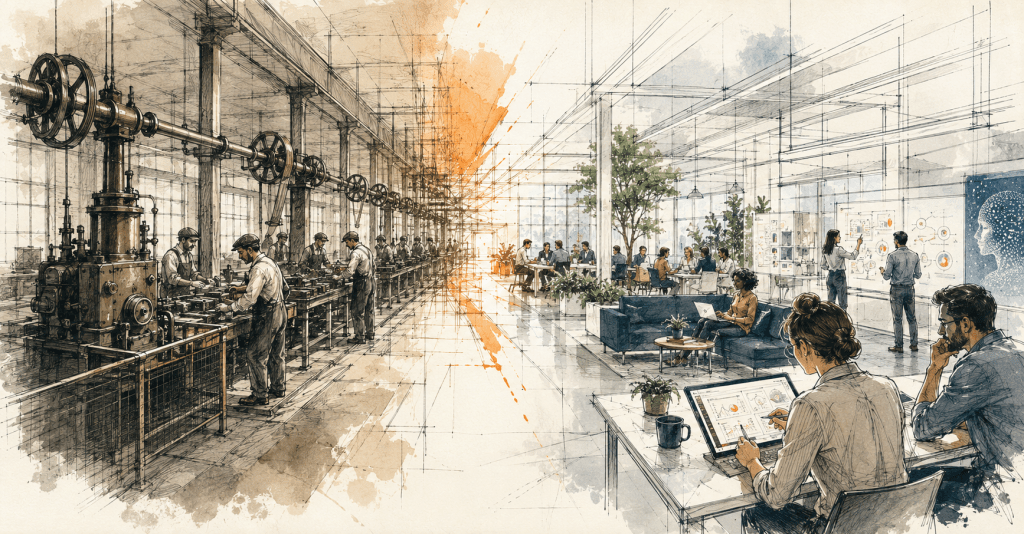
It’s 1900. The factory floor air is thick with coal smoke, and a single steam engine groans in the basement, its driveshaft running the length of the building, belts and pulleys hauling power to every machine on the line. A few years earlier, someone installed an electric motor down there instead of the steam engine because the boss told him so, but nothing else changed. Same shaft, same belts, same layout, same work productivity, just a quieter box in the basement.
That’s the story economist professor Ajay Agrawal tells about the early days of electrification. Twenty years after electricity reached American factories, only 3 percent of companies had adopted it. Not because it didn’t work. Because everyone kept bolting the new power source onto the old floor plan and calling it progress. The real 300-500 percent leap in productivity didn’t arrive until someone finally redesigned the entire factory around what electricity actually made possible.
The same thing is happening with AI transformation. Companies are being told to plug in the shiny new tool, but the transformation is currently meager because the early perceived value of slightly reducing operational costs from automation isn’t enough, yet.
The savvy leaders are the ones who recognize that the true benefits will come from redesigning business models, team resourcing, workflows and processes in a collaborative people-plus-AI approach.
Faster Isn’t the Goal. Different Is.
Imagine that the company just gave you 20 percent more resources. Most leaders would know exactly what they would do. While that’s exactly what’s happening now, leaders seem frozen. In BCG’s 2026 global survey of nearly 12,000 workers, 42 percent of regular AI users save a full workday’s worth of time weekly, yet 66 percent receive little to no guidance on what to do with that saved time, and more than half aren’t reinvesting it into strategic work.
Here’s the thing, faster and different are, well, different. Faster means AI does your existing job more quickly. Different means AI lets you do work you genuinely couldn’t do before, and different is where the real return lives.
“Artificial intelligence is not a strategy, but a means to rethink your strategy.” — Ginni Rometty, Former Chairman and CEO of IBM
The “Faster” Trap
Harvard Business School’s Iavor Bojinov draws almost the same line I’m drawing here: hours saved and cycle time shortened are real wins, but strategic advantage only shows up once efficiency gets converted into something new.
Here’s the thing: that doesn’t happen by accident. You have to go looking for it, and “What can I hand off?” isn’t the question that finds it. This is the one I actually use now:
Where does AI let us do something we genuinely couldn’t do before, and what guardrails does that require?
That’s a bigger question than it looks. It isn’t a one-off execution problem; it’s systemic, which means it needs a real human-plus-AI strategy, not just a running list of tasks you’ve automated. Which is where my rule comes in:
People for Purpose. AI for Process.
Human time goes to thinking, deciding, creating, and connecting. AI takes the repetitive, computational, large-scale work.
On my own list, that shows up as a kind of digital staff. AI is my brainstorming partner when I’m stuck on an angle, my researcher when a topic needs synthesis at scale, my editor when a draft needs tightening, and my designer when an idea needs a visual. Each of those is process work in service of a purpose I still set.
I used the rule while creating a recent piece. I had an idea but not the time to do the large-scale, computational work myself, so I set my AI researcher on the task: review 155 job descriptions and find the pattern. What I could do, what only I could do, was decide what it added up to and say it plainly. That’s different, and faster.
By the way, “different” isn’t free of risk. Research on AI delegation warns of a “paradox of automation”: hand off routine judgment calls consistently enough, and you can lose the situational awareness needed to catch the edge cases. That’s the guardrail half of the sharper question. Different work still needs a human deciding where AI shouldn’t run unsupervised.
Do This 10-Minute Audit
Run your own delegation audit, no extra tools required.
- List your last five AI delegations. Not hypothetical uses, the actual tasks you handed off this month.
- Ask the sharper question of each one. Did this let you do something you genuinely couldn’t do before? Or did it just do the same thing more quickly?
- Bucket honestly. “Faster” isn’t a failure; it’s process work, correctly delegated. “Different” is the one worth protecting and growing.
- Check the guardrails on your “different” pile. Where AI is doing something new, what judgment call still needs a human in the loop?
- Convert one task this week. Pick something stuck in “faster” and ask what it would take to make it a People for Purpose task instead, where you think, decide, or create, and AI handles the process underneath it.
Bottom Line
Fast forward 126 years. The coal smoke is gone, the driveshaft is gone, and so is the boss who once ordered a quieter motor bolted onto the same old floor plan. Now, I run the purpose. My digital staff runs the process. That’s the redesign it won’t take twenty years to figure out.
A “faster”-heavy list isn’t a failure. It’s just not the finish line.
Like this article? Subscribe now at ReturnOnMinute.com




Leave a Reply