

Leaders could get much quicker decisions and improve business outcomes but don’t because of unclear decision making. According to Bain research ambiguity over who gets to decide causes bottlenecks and bottlenecks slow progress.
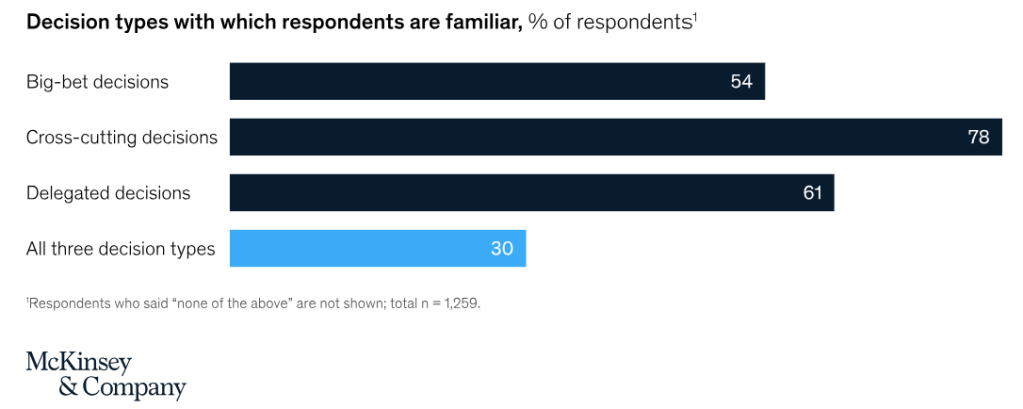
Additionally, many leaders treat all decisions the same. In a 2019 McKinsey survey only 30 percent of respondents say they are familiar with different types of decision making. Once a leader understands the difference, they can unlock better decision making.
McKinsey defines decisions this way:
- Big bets are rare, high-stakes, and shape the company’s future, like an acquisition.
- Cross-cutting decisions are broad like big bets but more frequent. They chain smaller decisions across groups, like pricing.
- Delegated decisions are frequent and narrow. One person or a working team handles them, with limited input, like a change to HR policy.
Why it matters: Making quick high-quality decisions is what gives businesses a leg up. Understanding how is what makes leaders stand out.
What’s next: Three myths, one rule for AI, and a practical guide.
Busted Myth 1: More information is better
Not necessarily. The right amount depends on the decision. Jeff Bezos, founder of Amazon, sorts them into one-way doors you can’t undo and two-way doors you can. For two-way doors, he says to decide with “somewhere around 70 percent of the information you wish you had.” For one-way doors, he asked for a slow, careful process.
Colin Powell, former head of US military forces and former Secretary of State, had a similar rule but one that also set a floor called the 40-70 rule. When you’re at 40 percent, you’re guessing. Waiting for certainty is almost always too late. The sweet spot is between 40 and 70 percent—where you have enough information to act, but not so much that you’ve missed your window.
Busted Myth 2: Faster means cutting people out
McKinsey warns that cutting debate participants to move quickly can hurt decision quality. Bain’s answer is to give everyone a defined role. In its RAPID model, people recommend, agree, give input, perform, or decide. One person is the “Decision Maker”, which creates single-point accountability.
Personal Lesson: The real key here is making sure there is only one decision maker, and you have the right one. I’ve seen many decisions get delayed or reversed because the “D” in RAPID was not the real decision maker. It was only after things went awry that a ghost decision maker was uncovered.
Busted Myth 3: Everyone has to sign off
In RAPID, anyone who vetoes must offer an alternative or escalate to the decision maker. GitLab runs the same way. Every decision there has one directly responsible individual who gathers input and makes the call without waiting for consensus.
Once the call is made, everyone backs it. McKinsey finds lasting gains in quality and speed require an organizational commitment to implement decisions rather than undercut them. Amazon turned the idea into a Leadership Principle, “Have Backbone; Disagree and Commit.” It asks leaders to challenge decisions even when unpopular. However, once a decision is determined, then commit wholly.
Where AI fits: gather, don’t decide
Looking to AI for decision making can be like a siren on a rock calling you in but enviably ends badly.
THE NEW RULE: People for Purpose. AI for Process
In other words, focus human time for thinking, deciding, creating, and connecting. Delegate the repetitive, computational, and large-scale work to AI. In practice use AI to gather and compare inputs on reversible decisions, keep one human owner, and keep a human challenger. On big bets and one-way doors, lean hardest on people, because mistakes there cost the most. Read more here.
A Cautionary Tale
In a 2025 Harvard Business Review experiment, nearly 300 executives and managers forecast Nvidia’s stock price a month out. Half could question ChatGPT. The other half talked with peers. The ChatGPT group grew more optimistic and confident, and produced worse forecasts. The authors point to the AI’s authoritative voice, unchecked by the skepticism the peer group supplied.
DADC: Define, Assign, Describe, Commit
Run this four-step checklist at the beginning of each project well before you get to decision time:
- Define the Decision Type. Start by defining the decision type Big-bet, Cross-cutting or Delegated. Then ask if you can undo it. The two questions are separate.
- Assign the Decision Maker. Name one person who decides. List who gives input and who must agree. Name one challenger to question the AI’s answer and yours.
- Describe the Data. For reversible calls, aim for about 70 percent of the information you wish you had. Have AI pull the inputs and compare your options side by side, then list what you still don’t know. For one-way doors, slow down and debate with people.
- Commit. Set the decision date. Anyone who objects brings an alternative. Once you decide, everyone backs it.
Copy this into your next decision doc or message:
Define: Decision needed: ___ (one sentence). Reversible: easy to undo / hard to undo. Decide by: ___. Cost of waiting: ___.
Assign: My recommendation: ___. Who else has weighed in: ___ (credit contributors, voice dissents).
Describe: What we know (2-3 key points, visuals inline): ___. What we don’t know yet: ___.
Commit: Anything else you need by [time]? If not, I’ll proceed with [recommendation] (reversible calls only).
Companies that decide well and fast, then execute quickly, report higher growth, returns, or both. The leaders who get there start by driving clarity and committing to it.
Like this article? Subscribe now.
Other articles you may enjoy
People for Purpose, AI for Process – Return On Minute
AI is not a productivity tool. It’s a prioritization tool. – Return On Minute
Five Time Saving Bets That Will Separate Leaders From Laggards in 2026 – Return On Minute
Headline image generated by AI





Leave a comment